David v Goliath
It was one of those nights. Lying awake at 2am, trying to fall asleep except for those stray random thoughts running amok in my head. Thoughts of fixing all the worlds problems, conversations had decades ago, long passed embarrassing moments, and still cringeworthy events. Amongst all this insomnia producing mental detritus, thoughts turned to that stupid banana taped to the gallery wall at Art Basel, Miami 2019.
I was thinking of the ridiculousness of it all. The banana, the duct tape, the inevitable controversy that stemmed from that one art fair defying performative act. Don’t get me wrong, I beleive it is an amazing piece of a modern objet d’art that rocked the art world so much that in essence ultimately questions ‘what is art?’ and its value considering its ephemeral nature versus the statement it was trying to convey. I pictured the banana taped on the gallery wall and the intellectual exercise it posed ‘where does this art sit in the canon of history?’. Instead of the gallery wall, what if Maurizio Cattelan’s Comedian was placed somewhere else like adjacent to a famous work of art? The Mona Lisa? No, too obvious. I then had a thought of the artwork being on a sculpture itself. Ephemeral on permanent. I had a vision of Michelangelo’s David bearing the burden of Cattelan’s fruit.
Ha, ha…a nice thought. I promptly went back off to sleep. However, the vision of the joined at the hip (literally) kept echoing in my mind for days afterwards. Beyond the intellectual exercise, sticking a banana on the actual David is just fantasy (well for me it is), but what if I reproduce it?
And so I did.
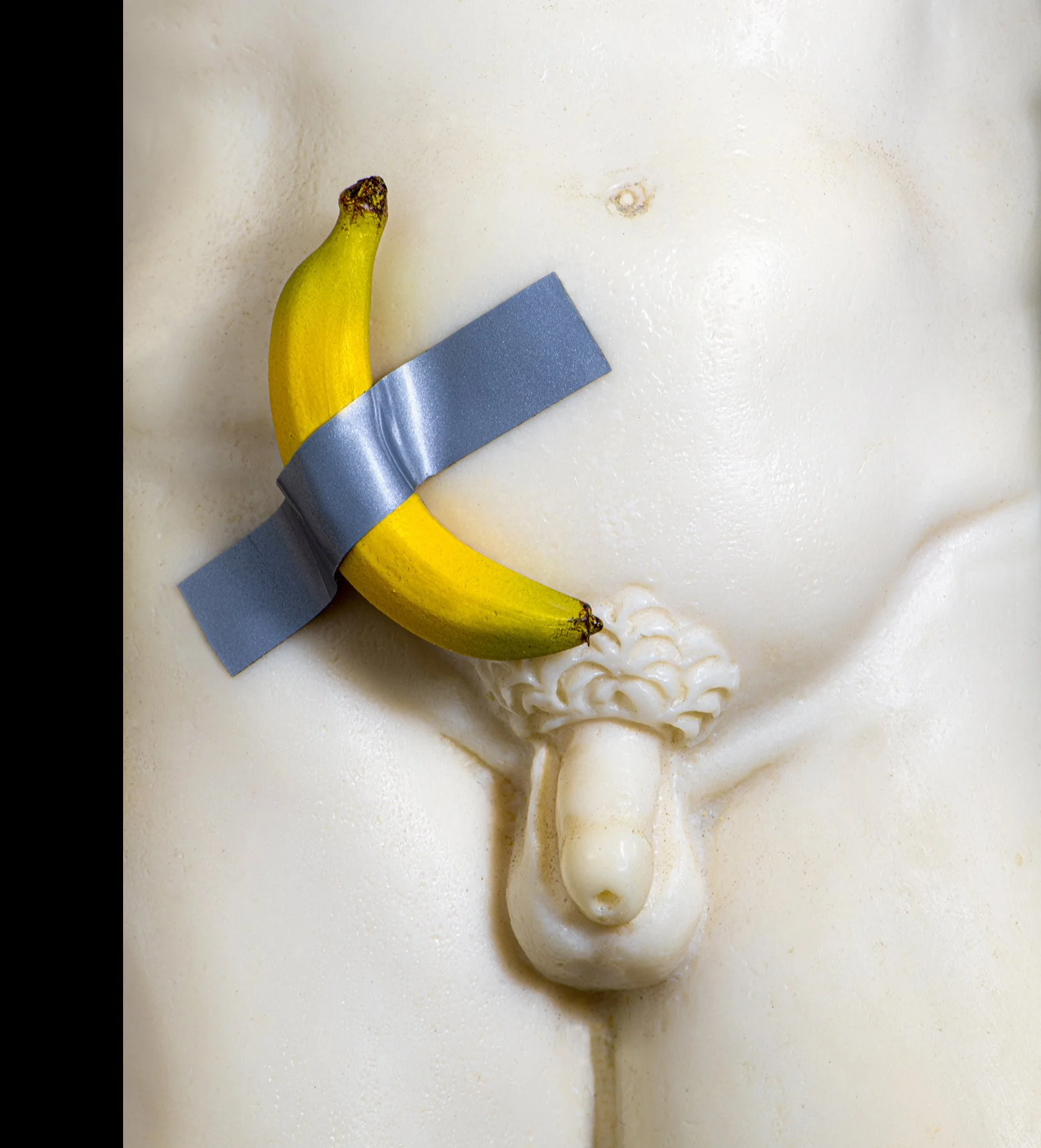
David v Goliath (2026)
Rationale
My work David v Goliath (2026) draws on the historical dialogue between the monumental and the absurd, positioning itself between David (1501/1504) by Michelangelo and Comedian (2019) by Maurizio Cattelan. Through humour, scale, and juxtaposition, this work stages a playful yet pointed confrontation between artistic traditions and the systems that sustain them.
At the centre of the photograph is a fragment of a classical sculpture resembling Michelangelo’s David. Rather than presenting the heroic whole, the image isolates the figure’s groin and taped across this marble fragment is a yellow banana, echoing Cattelan’s infamous expression in Comedian. Duct tape holds the fruit against the marble surface in a deliberately awkward encounter between permanence and ephemerality, high culture and everyday object. The contrast between materials intensifies this tension. Marble’s durability and cultural prestige, while the banana will inevitably bruise and decay. My work allows me to freeze this unlikely encounter in a suspended moment and in doing so, David v Goliath reflects on how artistic value shifts across time, and how small, absurd display can challenge the authority of even the most monumental traditions.
As in the title David v Goliath, this pairing becomes a visual metaphor for the biblical story of David and Goliath (1 Samuel 17). In Michelangelo’s sculpture, David represents the underdog who defeats an overwhelming opponent through intelligence and courage. Here, those roles blur. The monumental authority of Renaissance sculpture with its legacy of mastery, permanence, and reverence, becomes the “Goliath.” The banana, fragile and ephemeral, assumes the role of David: small, humorous, and seemingly powerless, yet capable of disrupting established hierarchies.
Humour plays a crucial role in this reversal. The image is knowingly irreverent, confronting the sanctity of art history by taping a banana to the body of a classical sculpture, the work mirrors Cattelan’s conceptual provocation while simultaneously grounding it within the weight of historical tradition. The image is both homage and critique acknowledging the endurance of canonical artworks while questioning the seriousness and authority that often surrounds them.
Ultimately, this work reflects on how artistic value is constructed across centuries. By collapsing Michelangelo’s Renaissance ideal and Cattelan’s contemporary provocation into a single frame, my work asks whether today’s irreverent gestures might themselves become tomorrow’s monuments. In this sense, David v Goliath stages an ongoing battle between reverence and disruption, reminding viewers that art history is not a stable hierarchy but a constantly shifting contest of ideas.